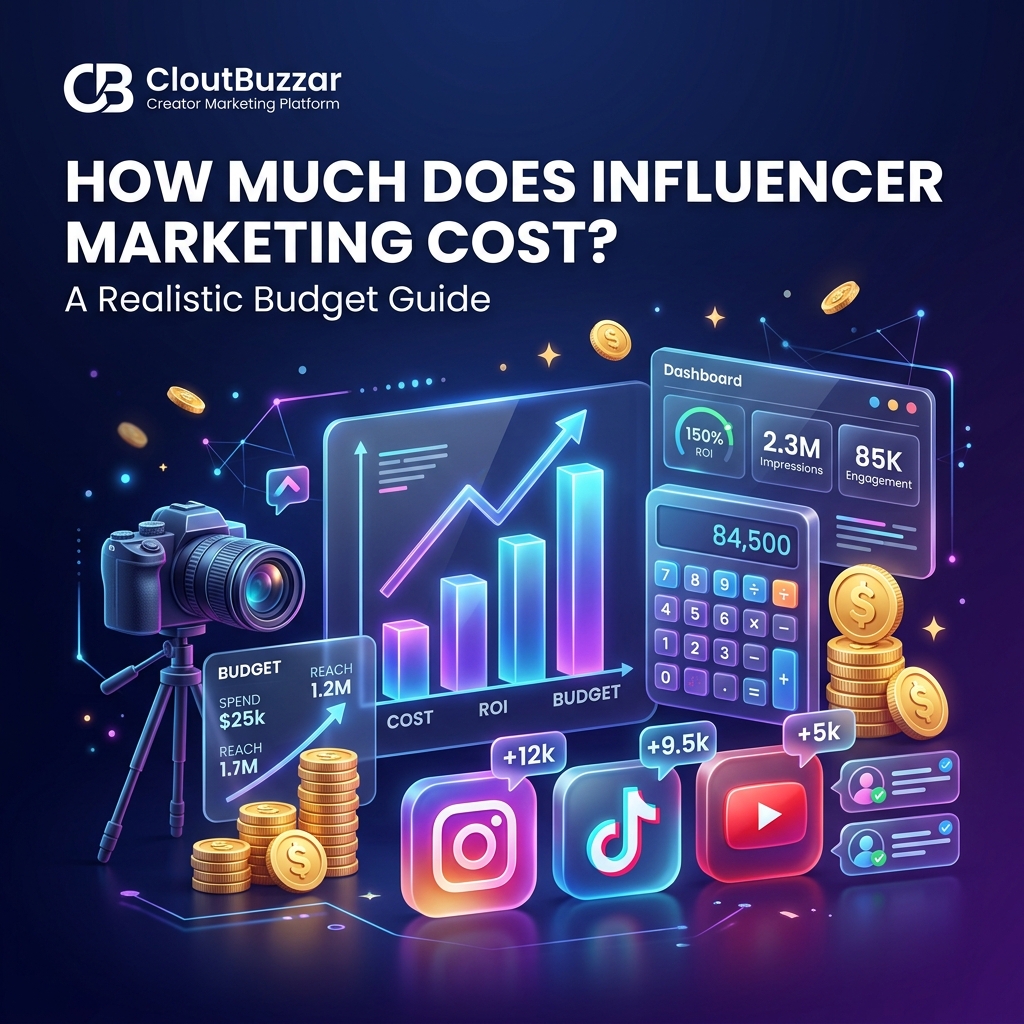
How Much Does Influencer Marketing Cost? A Realistic Budget Guide
Explore how much influencer marketing costs for different types of businesses, industries or sizes, factors, hidden costs and common mistakes brands should avoid.

Quick Summary
Influencer marketing has no single price tag. A nano creator might charge $25 a post while a mega influencer commands $50,000+, and most brands land somewhere between $500 and $15,000 a month depending on stage. The tier sets your range, but tracking and creator fit decide the actual return. Read this article to know exactly how much budget your business should plan.
Ask five brands what they spent on influencer marketing last year and you will get five different numbers, because there’s no fixed price tag on a “sponsored post”. Influencer marketing has grown from a $1.7 billion niche in 2015 to a projected $32.55 billion industry by 2025 and brands keep pouring more into it every year.
But what a single campaign actually costs depends entirely on which tier of creator you’re working with, which platform they are on and what you are asking them to create. According to Shopify’s pricing data, nano influencers (1K-10 K followers) charge as little as $25 to $150 per Instagram post, micro influencers run $250 to $5,000 and macro influencers can command $5,000 to $25,000 for a single piece of content.
While you choose influencers based on your budget, you need to know exactly how much influencer marketing costs overall including all the aspects.
How Much Does Influencer Marketing Cost in 2026?
There is no fixed cost of influencer marketing as it depends on various factors including creator’s follower count, audience quality, platform, content format, industry, location, campaign duration, usage rights, exclusivity and the ability to attract an audience and convert them into buyers.
Here’s the average cost breakdown by creator size and channel:
- Instagram: Instagram is one of the most used applications, where creators have wide audiences and strong engagement.
- TikTok: TikTok is a leading platform for authentic and short-form video collaboration between brands and influencers.
- YouTube: YouTube is the most powerful platform for long form videos influencer content. This platform continues to generate views and conversions months after publishing.
You can find the cost as per the platform in the table below:
| Type of Influencer | Follower Count | Instagram (per post) | YouTube (per video) |
|---|---|---|---|
| Nano | 1K- 10K followers | $25- $150 | $200- $1,000 |
| Micro | 10K- 100K followers | $250- $5,000 | $1,000- $10,000 |
| Mid Tier | 100K- 500K followers | $1,500- $10,000 | $8,000- $25,000 |
| Macro | 500K- 1M followers | $5,000- $25,000 | $10,000 - $50,000 |
| Mega | 1M+ followers | $10,000- $50,000+ | $20,000 - $50,000+ |
Instead of asking the cost of an influencer, ask ‘how should I invest to achieve my marketing goal?’
Answering the above question:
- If your goal is awareness, you can prioritize reach and impressions.
- If you are trying to generate sales, you can focus on conversions, affiliate revenue and cost per acquisition.
- If your goal is content creation, then focus on creators who produce high-quality, reusable content rather than follower count.
For most brands, the quick-witted approach in 2026 is to test multiple relevant creators, measure the outcomes, identify the best performing and scale partnerships that generate the best return. This gives you more control over your influencer marketing budget and allows you to choose the creator you can afford.
Factors Influencing Influencer Marketing Cost
The follower count is one thing but two creators with 10K followers can charge completely differently because their audience, engagement, niche, content quality, platform and commercial value may be very different.
Here are the factors that influence the cost of influencer marketing:
The bigger the following, the higher the baseline rate. The influencer tier explains the range rather than the exact budget to pay.
The engagement rate can differ depending on how engaged and real their audience is. The amount of save rates, comment rates and share rates justifies a premium.
The creator charges different costs for different platforms. YouTube integrations cost more than Instagram or TikTok for a similar audience as it requires long form video demands, more production time and holds attention longer.
Each content format like reels, static feed posts, videos, and stories usually cost different as they have different purposes. Static posts cost less than a Reel, Reels cost less than a video and stories are the cheapest since they disappear in 24 hours.
Creators charge more for finance, tech, B2B and health industries than general lifestyle or entertainment as their audience is harder to reach and considered higher intent by brands.
Repurposing of content in paid ads, brand website or across other marketing materials adds a separate fee as the base rate usually covers organic posting on the creator’s own channel.
If a brand wants they can ask a creator not to work with your competitor for a set amount of time, so it comes at a premium. It works like the narrower the exclusivity window/ category, the smaller that premium tends to be.
One-off post costs more than a multi-post series or an ongoing ambassadorship. Brands usually look for long-term partnerships that often unlock volume discounts. This may also mean a bigger total commitment.
When creators get full creative freedom they often charge less, partly because it takes them less time as they know their audience. The more detailed your brief (scripted lines, mandatory shots, multiple rounds of approval, the higher the rate they demand.
Creators represented by a manager or agency charge more, since that fee gets built into the rate. It usually buys smoother contracts and more professional turnaround. This is worth it for larger campaigns.
Hidden Costs Brands Often Miss
Brands often miss a few hidden costs when they plan a campaign. The rate you agree on with a creator is rarely the full number that hits the budget. Here’s the hidden cost when planning a campaign:
- Paid Amplification: If you want to run the content as a paid ad, it has a separate line item on top of the creator’s fee. You can negotiate upfront as getting a great organic post is half the equation.
- Usage Right Renewals: If the content performs well and you want to keep running it in ads or on your website past the window of usage, it comes with a renewal fee. Brands usually forget to track usage expiration dates and end up paying twice for the same content.
- Campaign Management & Discovery Tools: Standalone creator searching and campaign management platforms cost $200 to $1,000 a month on top of whatever you are paying creators because finding creators, tracking outreach and managing approvals takes software.
- Product & Shipping Costs: Product seeding isn’t free marketing. Factor in product cost, packaging and shipping even overseas or custom fees if you are working with international creators. This adds up fast across a larger seeding program.
- Revisions & Reshoots: Creators include a set number of revision rounds while accepting. Anything beyond that or a full reshoot because content missed the brief can come with an additional fee, especially if the content is in video format.
- Agency & Platform Fees: Affiliate, influencer marketplace platforms or an agency often take a cut like 15-25% on top of creator spend. This can be either a subscription or a percentage of tracked sales.
- Internal Time: One of the biggest hidden expenses is internal time which is rarely tracked. Sourcing creators, negotiating rates, reviewing content and chasing deliverables takes real hours from your team.
How Much Should a Business Budget?
With the price range of the type of influencers, you are aware of building a realistic budget. Since there is no universally accepted budget or fixed number, for better understanding for businesses diving into influencer marketing, we have created a budget based on the stages of brands:
Small Business or Early-Stage Brand: $500- $3,000/month
You need to keep this simple at this level. Focus on testing rather than scaling. You can split the monthly budget like:
- 3-5 nano or micro influencer posts, which can cost $500- $1,500
- Product/gifting can cost for a small seeding batch, which can cost $100- $500
- Start with basic campaign tracking like discount codes, affiliate links, this will have little to no added cost
Here the goal is to find out who drives results before you commit real money.
Growing Brand Running Regular Campaign: $3,000- $15,000/month
There are most brands that are ready to allocate or are already allocating 10-20% of their overall marketing budget. The budget usually shifts toward a repeatable monthly program once you have validated a few creators.
- 8-15 micro and mid tier posts across platforms, which costs around $2,500- $10,000
- Usage rights for top performing content, which costs approx $300- $1,500
- You need to spend $200- $1,000 for campaign management or discovery tools
- Keep a small reserve for one macro influencer test per quarter, which can generally cos $2,000- $5,000
This should be treated as an ongoing branding rather than a one-off experiment.
Established Brand Running Full Campaigns: $15,000- $100,000+/month
This stage of business usually faces a challenge which is not underspending but spending without a system. Budgets are usually split across a mix of tiers and not chasing the biggest names.
- A base of micro and mid tier creators for consistent volume and engagement
- Macro or mega influencer placements for reach focusing launches
- Paid amplification budget for top performing organic content
- You need an agency or in-house management costs, which can cost 15-20% on top of creator spend
Managing 20+ influencer relationships through spreadsheets and DMs is where budgets quietly leak into wasted outreach time, missed usage rights renewals and rates that never match.
Clout Buzzar
Clout Buzzar is built to connect brands and influencers. Businesses can search, compare and book creators directly on the platform. This way what you set aside actually goes to the creators making your content and not the overhead around finding them.
Start small, track what performs and let outcomes decide where the next dollar goes.
Influencer Marketing Pricing Models
Once you are aware of the budget, you need to know which model you use as it can change what you pay and how the risk is split between you and the creator.
This type of pricing model has a fixed rate for agreed deliverables. It’s predictable for budgeting and easy to negotiate, regardless of how the content performs. This is ideal for brand awareness campaigns, one-off launches and working with creators for the first time.
This type of pricing model is tied to rather than a flat deliverable. The creator estimates their typical views and you pay based on impressions delivered. Like, views/1,000*CPM rate. It rewards creators with strong reach and works well when the goal is visibility instead of direct response. Usually, ideal for awareness-focused campaigns on high view platforms like YouTube and TikTok.
The creator earns a percentage of sales generated through a unique link or discount code, with no upfront fee. In this type of pricing model, creators only get paid if the content converts which makes it attractive for brands with tight budgets. It is best for performance driven campaigns, smaller budgets and testing new creators at low risk.
A smaller guaranteed fee combined with a commission on sales. Like, $500 plus $10 per conversion. This gives the creator an income floor while still tying part of their payout to results that tends to produce better-aligned incentives than either flat fee or pure affiliate alone. This type is ideal for brands wanting performance accountability without asking creators to work entirely on spec.
In this type of pricing model, the creator receives free product in exchange for the possibility (not the guarantee) of a post. This works as a discovery mechanism more than a reliable promotion channel, since posting isn't contractually required. It is best suited for early-stage brands, seeding programs and identifying creators worth paying for later.
In this pricing model, A fixed monthly or campaign-length fee for ongoing content, typically with a minimum deliverable count (like, four posts a month) and sometimes exclusivity built in. Retainers cost more in total but reduce the per-post rate compared to booking the same creator repeatedly as one-offs, and they build the kind of consistent brand presence a single post can't. It is best suited for long-term partnerships with creators who've already proven results.
Common Influencer Marketing Budget Mistakes
Most influencer budgets don't fail because the number was too small. They fail because of how that money got spent. Here are the mistakes you might face, even from brands with a genuine budget to work with.
Chasing follower count over engagement
A bigger audience feels like a safer bet, but it rarely means a better return. A nano influencer with 8,000 loyal followers will often outperform a macro influencer with half a million passive ones. Check the engagement rate and comment quality before you look at the follower number.
Skipping the test phase
Committing a large budget to unproven creators is a gamble. One test post tells you more about fit and actual performance than any media kit or pitch deck ever will. Save the bigger checks for creators who have already shown they can deliver.
Locking in usage rights too late
Plenty of brands agree on a post rate and only bring up usage rights once the content is already live. By that point the creator has all the leverage and repurposing the content for ads or your website suddenly costs more than planned. Settle usage terms in the brief instead of after the fact.
Treating gifting as free marketing
Sending a free product does not guarantee a post and it definitely does not guarantee a good one. Brands that build entire campaigns on gifting alone usually end up with patchy results and nothing to show for it.
Running campaigns with no tracking
Paying a creator without a discount code, a trackable link or a defined KPI means you're guessing at your return after the fact. This makes it almost impossible to know which creators are actually worth rebooking. Try to set up tracking before launch.
Reaching for celebrity influencers too soon
A recognizable name feels like the obvious choice but the price rarely matches the return for a smaller brand's budget. Mid tier and micro creators usually bring more relevant content which is better converting audiences for a fraction of the spend. Save celebrity budgets for a stage where you can afford a miss.
Forgetting agency and platform fees
Many brands budget the creator's rate and stop there, leaving out agency fees, platform subscriptions, or tool costs stacked on top. A campaign that looked like $5,000 quietly turns into $7,000 once those extras get added. Build the full cost picture before you take a number to leadership.
Booking one campaign and calling it done
A single sponsored post rarely builds lasting recall, no matter how well it performs on its own. Brands that see the strongest long-term results tend to work with a smaller group of creators repeatedly instead of a new face every time. Consistency compounds in a way one-off posts can't.
Final Thoughts
Influencer marketing cost isn't a fixed number. It's a range that moves with follower tier, platform, content format and how you structure the deal. The brands that get the best return aren't the ones spending the most. They're the ones who understand exactly what they're paying for, track results from day one and build relationships with creators instead of chasing one-off posts.
Start small if you're new to this. Test a handful of creators, watch what actually converts and let the data tell you where to put the next dollar. As your roster of partnerships grows, the right tools make it easier to keep that spending disciplined instead of scattered across spreadsheets and DMs.
Whatever budget you land on, treat it as a starting point, not a fixed plan. The best influencer programs get sharper every quarter, not because the spend goes up, but because the decisions behind it get smarter, and CloutBuzzar is built to make that process a lot less painful.
FAQs
Is it cheaper to work with micro-influencers?
Yes, in most cases. Micro-influencers charge significantly less per post than macro or mega creators and they often bring higher engagement rates for the price. A brand can book several micro-influencers for the cost of one macro campaign and reach a more targeted, more engaged audience in the process.
How much should a small business spend on influencer marketing?
Most small businesses can start meaningfully with $500 to $3,000 a month, focused on nano and micro-influencer posts along with a small product seeding budget. The goal at this stage isn't scale. It's finding out which creators actually move the needle before committing more money.
Do influencers charge separately for usage rights?
It totally depends on the creators. A standard rate covers organic posting only on the creator's own account. If you want to repurpose that content in paid ads, on your website or across other marketing channels, you can expect an additional fee that scales with how long and how widely you plan to use it.
How can I get better ROI from influencer marketing?
Track every campaign with unique discount codes or trackable links so you know exactly what each creator delivers. Prioritize engagement rate and audience fit over follower count, negotiate usage rights upfront and rebook creators who perform well instead of starting over with someone new each time.
How much do influencers charge per post on average?
There's no single average since it depends heavily on platform and tier, but a common benchmark for a micro-influencer Instagram post lands somewhere between $250 and $5,000. Nano creators can charge as little as $25, while macro and mega influencers regularly charge five figures for a single post.
Is influencer marketing worth the cost?
For most brands, yes. The channel returns an average of $5.78 for every $1 spent, and top performing campaigns return significantly more. The return depends heavily on picking the right creators and tracking performance properly, rather than treating it as a set-and-forget spend.